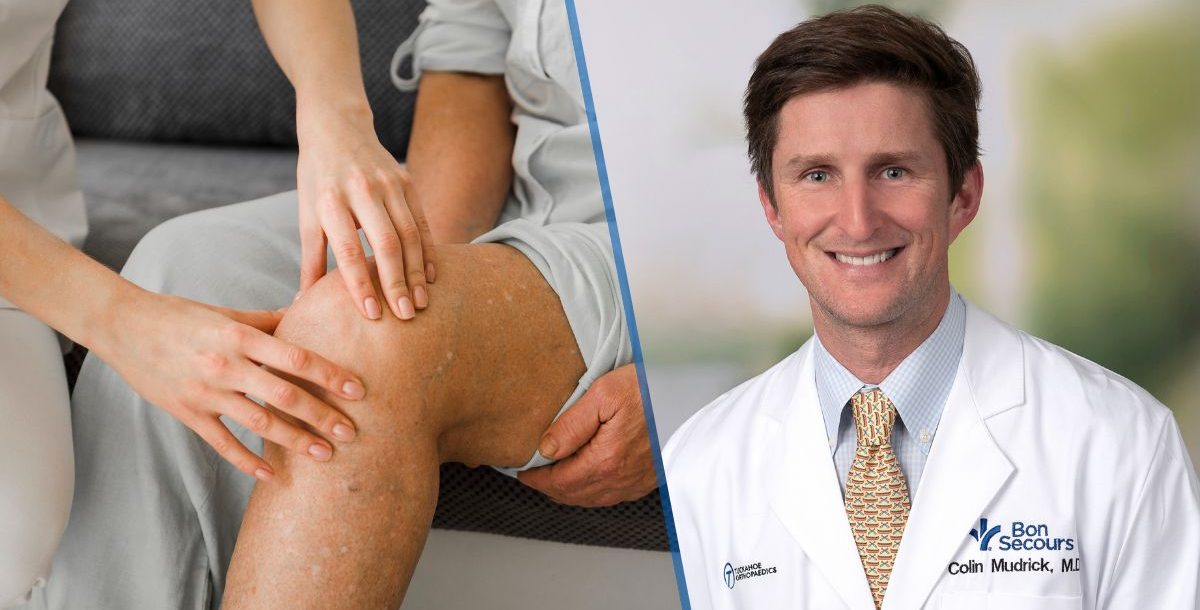
The best knee replacement surgeons hope you’ll forget about your knee. In fact, that’s the standard they’re aiming to achieve. That’s why a Bon Secours orthopedic surgeon developed the SPORTS KNEE™ procedure.
Robotic surgery for knee replacement is not only about pain relief and restored mobility. Colin Mudrick, MD, a hip and knee specialized orthopedic surgeon in our Richmond market, says the primary goal and clinical benchmark of this procedure should be that you stop thinking about your knee entirely.
“We define success as a patient being able to pursue activities like hiking, skiing and pickleball without thinking about or being limited by their knee that has been replaced, or better yet, restored,” Dr. Mudrick says.
The first step to learning more about the SPORTS KNEE™ procedure is to schedule a consultation. Make an appointment to begin the process and find out if you’re a good candidate for this procedure.
What is the SPORTS KNEE™ procedure?
That clinical benchmark has a name: the Forgotten Joint Score. It measures how often a patient is aware of their replaced knee during daily activity. A perfect score means your knee has faded into the background of your life.
Dr. Mudrick performs what he calls the SPORTS KNEE™ replacement – a combination of five advanced surgical techniques designed to get patients to that forgotten-knee outcome faster, with less pain and with a more natural-feeling result. It’s an approach patients travel across the region to access, because few surgeons anywhere use all five techniques together.
Who is a candidate for minimally invasive knee replacement surgery?
Total knee replacement isn’t the first option, but it serves as a permanent solution to arthritic knee pain once you have exhausted other options.
The SPORTS KNEE™ procedure is designed for patients with advanced knee osteoarthritis. This is when bone rubs directly against bone, and the cartilage that once cushioned the joint has significantly worn away.
If you’ve tried conservative treatment (physical therapy, anti-inflammatory medications, cortisone or hyaluronic acid injections and activity modification) but your pain and function haven’t meaningfully improved, it could be right for you.
One common concern among candidates is whether a newer surgical technique carries greater risk. For the SPORTS KNEE™ approach, the answer is straightforward. “There are no increased risks when compared to traditional knee replacement,” Dr. Mudrick says.
What is the SPORTS KNEE™ replacement?
The SPORTS KNEE™ replacement is a total knee replacement procedure performed by Dr. Mudrick. It brings together five distinct surgical techniques under a single acronym. Together, they represent what Dr. Mudrick describes as “a marriage of advanced techniques and forward-thinking surgical philosophy to maximize patient outcomes.”
The results have drawn patients from well beyond Richmond, Va. “We have patients who travel from more than three hours away in order to gain access to this specific treatment,” Dr. Mudrick says.
Here’s what each element of SPORTS means for a patient.
S: Subvastus approach – knee replacement without cutting the quad muscle
In a traditional knee replacement, the surgeon accesses the joint by cutting through the quadriceps muscle and tendon (the median parapatellar approach). Because the quad is responsible for moving the knee, recovery can be significantly longer when it is cut.
Dr. Mudrick uses a different route in. The subvastus approach goes under the quad muscle rather than cutting through it. “The aim of this approach is to allow the quadricep – the main driver of knee function – to recover faster with less pain after surgery.”
P: Personalized alignment – a knee replacement designed around you
Since the 1970s, total knee replacement has been guided by a principle called mechanical alignment. Knee replacements used the same angle for every patient. The problem is that no two knees are the same.
“To achieve consistent success, we need to understand each patient’s specific knee ‘personality’ in order to restore their native knee function,” Dr. Mudrick notes.
This idea is called kinematic alignment, which positions the implant to match each patient’s own natural knee anatomy. The goal is to restore the knee you had before arthritis damaged it. Robotics allows this level of personalization to be precise and repeatable.
O: Outpatient – going home the same day
More than two-thirds of Dr. Mudrick’s knee replacement patients go home the same day as their surgery. When less muscle and tissue is disturbed during the procedure, the body has less trauma to recover from, and patients are up and moving faster.
R: Robotics – precision that manual surgery can’t match
Every knee replacement involves cutting and reshaping the bone to accept the implant. Precision determines how well the implant sits and how naturally the joint moves.
Dr. Mudrick uses a new-generation robotic surgical system to perform SPORTS KNEE™ replacements. Before any cuts are made, the robot builds a detailed map of each patient’s individual knee anatomy. That map guides the surgical plan. The surgeon uses robotic tools to make precise cuts in the bone.
T: Tourniquet-free – less swelling, less pain
Many knee replacements are performed with a tourniquet – an inflated cuff around the upper leg that restricts blood flow during surgery.
While the technique is common, Dr. Mudrick points out it comes with a cost. “This causes muscle damage and restricts blood flow for an extended period of time. I abandoned the use of a tourniquet several years ago with the goal to minimize muscle and vessel damage during surgery, which allows for less post-operative swelling and pain.”
Performing knee replacement without a tourniquet is part of the same guiding philosophy that shapes every element of SPORTS: reduce trauma to the surrounding tissue, and the body heals faster and better.
S: Sedation anesthesia – avoiding complications from general anesthesia
Patients are given sedation, sometimes called “twilight” anesthesia, instead of general anesthesia. General anesthesia requires a breathing tube (intubation) and has a higher chance of side effects. Patients with sedation often experience less nausea and avoid the mild confusion that can sometimes happen with general anesthesia.
In Dr. Mudrick’s experience, many patients are relieved to find out that they don’t have to go all the way “under,” but will still not be aware or awake during any part of the procedure.
How fast is recovery after SPORTS KNEE™ replacement?
Recovery anxiety keeps many knee replacement candidates from taking the next step. The SPORTS method can make recovery more bearable.
Patients are moving again from day one because the quad muscle is preserved, the tourniquet is never inflated, and the procedure minimizes damage to surrounding tissue.
“When utilizing the SPORTS method, our patients are able to climb stairs, go to the bathroom and get to the kitchen independently using a walker on day one of surgery,” Dr. Mudrick says. “We have had many patients who were walking in the neighborhood without a cane or walker in fewer than seven days after surgery.”
Returning to higher-level activity – hiking, skiing, pickleball – takes longer. Many patients return to athletic activity around week eight.
“Everyone has a slightly different recovery path, but many people achieve a forgotten joint before one year,” Dr. Mudrick says.
How we can help
Dr. Colin Mudrick specializes in total knee replacement. He developed the SPORTS KNEE™ method to address what he saw as a gap between what knee replacement surgery could accomplish and what most patients were experiencing – an approach that has drawn patients from across Virginia and beyond.
If you’ve been living with knee pain that conservative treatment hasn’t resolved, or if you’ve been told knee replacement is in your future, make an appointment to schedule a consultation. The SPORTS KNEE™ technique is designed for patients who want to get back to the life they had – hiking, playing sports, staying active – not just back to managing pain.
Learn more about orthopedics and sports medicine at Bon Secours.